- 58 El Hegaz Street, Heliopolis, Egypt
- +201091818229
- info@after-graphic.com
- Login
- Track Order

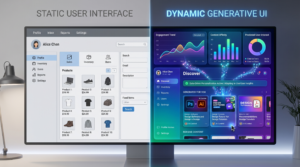
When we talk about AI-driven UI/UX design, we are discussing a massive, irreversible paradigm shift in the digital world. The landscape of user interface and user experience design is undergoing a radical, structural transformation driven by artificial intelligence. No longer confined to static, unyielding templates and manual iteration cycles, modern design systems are now capable of learning, adapting, and evolving in absolute real time based on actual user data.
The profound synergy between advanced AI and user interface design has unlocked an entirely new class of digital experiences. We are now building interfaces that feel genuinely personal, remarkably intuitive, and astonishingly intelligent. At After Graphic Studio, we recognize that building a digital product today requires the precision of an architect and the foresight of a technologist. With 20 years of experience in creative direction and structural design, we approach UI/UX not just as digital painting, but as engineered digital architecture.
AI methodologies such as generative UI and predictive UX have decisively emerged as the frontline tools in this digital transformation. These highly innovative approaches allow design systems to dynamically adjust based on granular user behavior, personal aesthetic preferences, and immediate session context. Designers who successfully harness AI’s immense capacity to process and analyze vast behavioral datasets can craft highly adaptive interfaces.
These adaptive systems are not only visually compelling but also measurably more effective at guiding users toward meaningful actions. They drastically increase overall engagement, slash bounce rates, and elevate customer satisfaction to unprecedented levels. In this comprehensive guide, we will explore exactly how AI-driven UI/UX design is rewriting the rules of the digital economy and how your brand can leverage it.
Generative AI is an incredibly advanced branch of artificial intelligence primarily focused on producing new, original content or structured digital outputs. It operates by training sophisticated neural network models on incredibly large, complex datasets, enabling them to recognize deep aesthetic patterns. In the specific realm of AI-driven UI/UX design, generative AI enables the seamless, programmatic creation of dynamic, user-centric interfaces.
The practical, daily application of generative AI in design primarily centers on its unparalleled ability to personalize at an enterprise scale. By intricately analyzing user behavior trends across various demographics, generative models can accurately predict exactly how different audience segments are likely to interact with a given software interface. This is not guesswork; it is high-level statistical probability applied to digital aesthetics.
This predictive capacity feeds directly into profound design personalization. It ensures that website layouts, brand color schemes, typography choices, and content hierarchies are meticulously optimized for the specific needs of each distinct user group. Moreover, generative AI firmly extends into the realm of real-time design adaptation. Interfaces built on these modern principles automatically restructure themselves while the user is actively browsing.
They continuously adjust navigation patterns, visual emphasis points, and interactive call-to-action buttons based entirely on live user input. This real-time responsiveness is a critical, powerful lever for conversion optimization. It directly reduces cognitive friction and aligns the interface precisely with the user’s current search intent, ensuring a frictionless journey from landing page to checkout.
Generative UI refers to the visionary design philosophy of building digital interfaces that are not fixed, but highly fluid. They are fully capable of evolving organically in response to real-time data streams. Unlike traditional static design methodologies—which deliver an identical, generic experience to every single user regardless of their context—generative interfaces shape themselves specifically around the individual viewing them.
At its technical foundation, generative UI is completely powered by continuous, aggressive behavioral analysis. By systematically collecting and interpreting micro-signals such as mouse scroll depth, precise click patterns, hover dwell time, and complex navigation paths, the system successfully builds an ever-evolving digital model of user intent. It acts almost like a digital concierge, quietly observing and anticipating needs.
Predictive UX layers seamlessly on top of this strong foundation. It uses historical interaction data to actively anticipate what users are most likely to need next, proactively surfacing highly relevant content before the user even has to search for it. The core distinction between traditional static design and AI-driven UI/UX design lies in this complete, unyielding adaptability.
Static UI unfairly locks every user into the exact same predetermined journey; generative UI beautifully allows each user’s path to be uniquely shaped. This deep level of personalization has proven to be highly effective for massive conversion rate optimization (CRO). Users who encounter interfaces specifically tailored to their exact preferences convert at significantly higher rates.
Big data is the undeniable, roaring engine that powers all successful AI-driven UI/UX design. Without access to rich, highly accurate behavioral data, even the most advanced machine learning algorithms have absolutely no foundation for making meaningful predictions. Modern UI/UX design teams must place unwavering emphasis on building robust data collection architectures.
The precise types of data relevant to highly accurate predictive modeling span a very wide spectrum. This includes basic demographic attributes, deep session-level behavioral signals (such as micro-clicks and scroll velocity), device and platform context, and granular geographic location. Each distinct data layer intelligently adds necessary nuance to the predictive model, enabling much finer-grained personalization.
Machine learning algorithms process this massive influx of data continuously, refining and sharpening their predictions as user behavior naturally evolves over time. Unlike outdated, rigid rule-based systems that require tedious manual updates from backend developers, ML-powered UX systems improve organically. They learn from their mistakes and double down on their successes without human intervention.
However, it is equally important to approach this level of data collection with a strictly enforced ethical framework. Explicit user consent, completely transparent data usage policies, and strict compliance with international privacy regulations are absolutely non-negotiable. Deep user trust is the essential prerequisite for any highly effective, data-driven generative UI strategy.
Highly effective UI/UX design has always been deeply grounded in a profound understanding of human psychology. Elements such as color palettes, typography choices, spatial composition, and micro-motion animations all trigger subtle emotional responses. AI magnificently amplifies this crucial dimension by enabling deep psychological personalization at a granular level.
Color theory offers a well-established framework for understanding emotional impact. Warm tones naturally activate feelings of urgency, making them highly effective for limited-time offers. Cool tones convey peace and trustworthiness, making them logical choices for secure platforms. When AI makes these strategic choices intelligently in real-time, it creates a coherent emotional experience.
Generative UI bravely extends this emotional design concept directly into dynamic adaptation. By instantly adapting page layouts and background imagery to match individual user preferences, emotionally intelligent AI interfaces actively create a profound sense of being understood. This is a powerful driver of intense brand loyalty.
When users genuinely feel that a digital product intuitively responds to their exact needs, the entire relationship immediately shifts from a cold software transaction to a warm, meaningful connection. This psychological bonding is the ultimate goal of advanced predictive UX, ensuring users return not just for the service, but for the feeling the interface gives them.
At After Graphic Studio, we often draw parallels between physical architecture and AI-driven UI/UX design. Having spent 20 years mastering structural design and creative direction, we understand that a website is a digital building. It needs a solid foundation, clear navigation (hallways), and aesthetically pleasing, functional spaces (pages) where users can achieve their goals.
AI acts as the dynamic environmental control system of this digital building. Just as a smart building adjusts lighting and temperature based on occupancy, a generative UI adjusts its layout and content density based on cognitive load. If the AI detects a user navigating rapidly and confidently, it might streamline the interface to offer quick, advanced shortcuts.
Conversely, if the AI detects hesitation—indicated by slow scrolling or erratic mouse movements—the interface can automatically expand helper text, simplify menus, or trigger an unobtrusive chatbot offering assistance. This architectural mindset ensures that we are not just decorating web pages; we are engineering highly functional, responsive digital environments designed to serve human needs perfectly.
Investing in AI-driven UI/UX design is not merely a technological upgrade for the sake of modernization; it is a calculated, strategic business decision that yields highly measurable Return on Investment (ROI). Traditional design overhauls are notoriously costly, intensely time-consuming, and heavily reliant on guesswork or extremely limited focus group data.
In sharp contrast, AI-powered adaptive interfaces continuously optimize themselves. They ensure the digital product is always performing at its absolute peak potential without requiring constant, expensive manual redesigns by agency teams. From a pure financial perspective, the integration of predictive UX drastically lowers customer acquisition costs (CAC).
When a WooCommerce store or corporate landing page dynamically adjusts its messaging to perfectly match the profile of a visiting user, bounce rates plummet instantly. The conversion rate from casual visitor to paying customer naturally increases, directly boosting the company’s bottom line and multiplying the effectiveness of existing paid advertising campaigns on Google or Meta.
Furthermore, AI-driven personalization plays a critical role in long-term customer retention and maximizing lifetime value (LTV). Users are significantly more likely to return frequently to a platform that “remembers” them accurately and intuitively presents relevant products. Reducing digital friction directly fosters deep-rooted user habits and brand advocacy.
After Graphic Studio has firmly positioned itself at the absolute forefront of AI-integrated digital design. We expertly apply advanced generative UI and predictive UX principles across a highly diverse portfolio of successful client projects. Our “Sana’eya” approach means we treat AI not as a replacement for human skill, but as the ultimate power tool for master craftsmen.
One instructive example involved developing a massive e-commerce platform for a high-end client. The core challenge was delivering a meaningfully personalized shopping experience to a customer base with widely varying aesthetic tastes, financial budgets, and distinct cultural browsing behaviors. A static WordPress template was simply not going to cut it.
Our expert team devised a brilliant solution centered entirely on cutting-edge generative UI techniques. Sophisticated AI algorithms continuously processed live behavioral data—including scroll depth and category affinity—to seamlessly adjust crucial UI elements. We dynamically changed product ordering, shifted visual emphasis, and altered the tone of call-to-action buttons on the fly.
The highly measurable outcomes validated this innovative approach decisively. Comprehensive post-launch analysis clearly revealed a massive 35% increase in average user session duration and a stunning uplift in overall checkout conversion rates. This provided clear evidence that AI-driven UI/UX design is the ultimate key to unlocking hidden revenue streams.
Implementing generative UI requires a robust, scalable technical stack. For many of our enterprise and mid-market clients, this foundation is brilliantly built upon WordPress and WooCommerce, enhanced by plugins like Elementor for structural flexibility. However, the true AI magic is injected using powerful workflow automation tools like n8n.
Using custom APIs and webhooks, we connect these traditional CMS platforms to advanced Large Language Models (LLMs) like Claude or OpenAI. This allows the website interface to securely pass user behavioral data to the AI, which instantly returns customized HTML/CSS adjustments or personalized copywriting directly to the user’s browser.
For Search Engine Optimization, this dynamic capability is paired with tools like Rank Math Pro. AI evaluates the content density, semantic relevance, and keyword targeting in real-time, ensuring that while the UI is adapting to the human user, the underlying code remains perfectly structured and easily crawlable for Google’s indexing bots.
Despite the overwhelming, undeniable benefits of AI-driven UI/UX design, integrating these complex systems is not without its distinct technical and strategic challenges. One of the primary hurdles teams face is the notorious “cold start problem.” AI models absolutely require substantial amounts of data to make accurate predictions.
When a completely new product or feature is launched, there is often a lack of historical data. This means the generative UI may initially struggle to provide meaningful personalization until sufficient traffic is generated. To combat this, we often utilize broad demographic baselines and rapidly conduct A/B testing to feed the initial algorithms.
Another significant challenge lies in maintaining strict brand consistency. While allowing an AI to dynamically alter layouts and typography can boost conversions, it also risks diluting the core visual identity. Design teams must establish strict algorithmic boundaries—often referred to as “Design Tokens”—to ensure the UI never breaks the brand’s fundamental guidelines.
Finally, there is the real risk of creating digital “filter bubbles.” If a predictive UX system becomes too aggressive in only showing users exactly what it thinks they want, it can prevent organic discovery of new products. Striking the perfect balance between hyper-personalization and encouraging exploration requires continuous human oversight.
The exciting trajectory of AI-driven UI/UX design points directly toward digital interfaces that are increasingly autonomous, deeply context-aware, and profoundly emotionally intelligent. Extreme hyper-personalization will very soon become a standard baseline expectation for all software, rather than a unique, high-end market differentiator.
Advanced voice recognition and complex multimodal interfaces represent another massive frontier. As AI language models become capable of understanding nuanced human intent, digital interfaces will extend beyond the flat screen to encompass natural voice commands and immersive 3D spatial environments, requiring an entirely new architectural mindset from designers.
The bright future of digital product creation undoubtedly belongs to those who understand that technical adaptability is the absolute foundation of modern design. The rare ability to successfully create dynamic interfaces that intelligently learn and empathetically respond to their users will definitively separate truly leading digital experiences from the mediocre rest.
For modern design professionals and forward-thinking tech companies, the strategic imperative is incredibly clear: embrace AI-driven UI/UX design deliberately. At After Graphic Studio, we are committed to leading this charge, combining decades of architectural design discipline with the bleeding edge of generative AI to build the ultimate digital experiences for our clients.